
Electricity- Electricity is the presence and flow of electric charge. Its best-known form is the flow of electrons through conductors such as copper wires. ... When the charges are not moving, electricity is called static electricity. When the charges are moving they are an electric current, sometimes called 'dynamic electricity'.
Electric charge-Electric charge is the physical property of matter that causes it to experience a force when placed in an electromagnetic field. There are two types of electric charges; positive and negative (commonly carried by protons and electrons respectively). Like charges repel and unlike attract.
Current-An electric current is a flow of electric charge. In electric circuits this charge is often carried by moving electrons in a wire. It can also be carried by ions in an electrolyte, or by both ions and electrons such as in an ionised gas (plasma).
Potential-The electric potential at a given point is the magnitude of potential point at that point per unit charge. But a much better definition is: Electric potential at a point is defined as the amount of work done in moving a unit positive charge from infinity to that point.
Resistance-Resistance is the opposition that a substance offers to the flow of electric current. ... When an electric current of one ampere passes through a component across which a potential difference (voltage) of one volt exists, then the resistance of that component is one ohm.
_________________________________________________________________________
THE OHM'S LAW
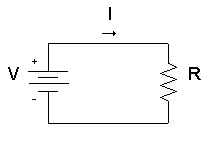
Ohm's law states that the current through a conductor between two points is directly proportional to the voltage across the two points. ... More specifically, Ohm's law states that the R in this relation is constant, independent of the current.
.
_________________________________________________________________________________

No comments:
Post a Comment